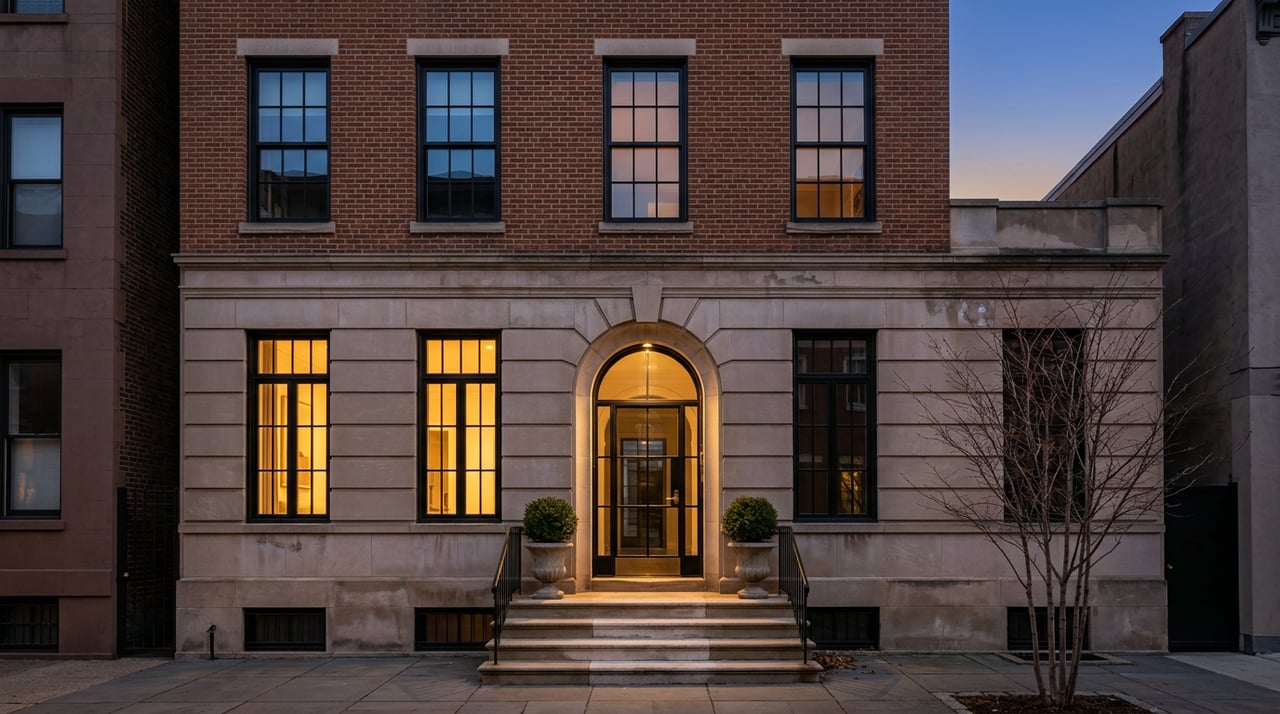
I've walked past 100 E. Ontario more times than I can count, most of those years when it was Lawry's, the smell of prime rib drifting out onto the sidewalk on my way to a showing. The restaurant closed in 2020, and for a while the mansion just sat there, handsome and dark, like a party that had ended early. This spring it reopened as something none of us expected: a $50 million magic theater called The Hand and The Eye, built inside the Italian Renaissance house Leander Hamilton McCormick had built for his family in 1899, long before it ever served a meal to the public.
That single address tells you more about Near North Side this year than any list of new menus could. The neighborhood isn't getting bigger. It's getting reused. The most interesting changes on Wells, LaSalle, and Ontario this summer didn't come from new construction. They came from old rooms finding entirely new reasons to open their doors.
A Steakhouse Becomes a Magic Mansion
The Hand and The Eye opened April 18 inside a building that has already lived several lives: private residence, puppet opera theater, members-only nightclub, and for more than four decades starting in 1974, Lawry's The Prime Rib. Investor Glen Tullman and designer David Rockwell gutted the interior down to its studs, keeping the grand staircase and a few historic details, and turned the mansion into more than 37 rooms that function as performance spaces, with names like The Grand Salon and The Red Herring.
Bre Smith, the venue's EVP of Operations, put it plainly to Chicago Magazine: "A lot of people think this is dinner with magic. That's not what it is." Guests get a hand-illustrated map at the door and move through the mansion at their own pace, a cocktail here, a close-up show there, dinner somewhere else entirely. Levy Restaurants, the company behind food service at the United Center, runs the kitchen.
What I find most telling isn't the spectacle. It's the choice. A building that spent four decades as a formal steakhouse could have reopened as another restaurant, another hotel bar, another version of what was already there. Instead it became something the neighborhood didn't have before, on a street residents already walk every day. If you've lived on or near Rush Street long enough to remember waiting for a table at Lawry's, that corner now asks something different of you on a Friday night.
The River Became the Address Everyone Wants
Walk two blocks west and the pattern repeats, just with water instead of magic. In May, DineAmic Hospitality opened NAIA at 300 N. LaSalle, a 12,000-square-foot pan-Mediterranean restaurant that spans nearly a full city block along the Chicago River. The restaurant seats 250 indoors and 150 more on a patio built around a crudo counter that overlooks the water, drawing on Southern French, Spanish, Italian, and Levantine cooking.
A few blocks over, Lettuce Entertain You opened Kitty's Cosmopolitan Club on March 27, tucked into the lower level of 51 W. Hubbard. The food comes from James Beard Award-nominated chefs Thai Dang and Bob Broskey, and the cocktail program includes what the owners say is Chicago's first dedicated mixing station built inside a walk-in freezer that runs 16 degrees below zero. It's open five nights a week, Wednesday through Sunday, in a basement that had nothing like it a year ago.
Both spaces chose proximity to the river over almost anything else, which matters if you've noticed that the sidewalk along 300 N. LaSalle, once a quiet approach to an office tower, now carries real foot traffic after five in the afternoon. That short stretch used to be the fastest way down to the Riverwalk. This year it's also a destination in its own right.
The Block That Hasn't Caught Up Yet
Not every reopening has landed cleanly. The Boka Restaurant Group, the team behind some of the city's most decorated dining rooms, opened Gingie at 707 N. Wells in late March, replacing their steakhouse GT Prime in the same room. Chef Brian Lockwood, making his first solo restaurant after consulting on the FX series "The Bear," built a menu that mixed Japanese technique with European plates, seafood running through nearly every course.
Then a fire closed the space. As of the most recent reporting available in late July, it remained dark with no announced reopening date. That block of Wells between Superior and Huron has gone quiet in a way it hasn't in years, which is a strange thing to notice if you're used to walking past a lit dining room on your way home. Boka has too much invested in that address, and too much reputation riding on it, for the room to sit empty indefinitely. But if you've been wondering why a restaurant that opened with real momentum suddenly stopped taking reservations, a fire is the reason, and it's worth checking before you plan an evening around it.
It's the kind of gap that a neighborhood absorbs quietly. Nobody puts up a sign explaining a fire. You just notice the windows are dark and adjust your route.
What's Still Running While the Rest Settles
Not everything about this summer required a renovation. Some of the neighborhood's best fixtures just kept showing up on schedule.
- Taste of River North ran July 17 and 18 this year on Wells Street between Ontario and Chicago Avenue, with a dog parade at noon Saturday and live bands through the evening, including a run of tribute acts that has become something of a tradition on that stretch.
- Art on theMART kept its evening projection run going on the south face of the Merchandise Mart this summer, visible from the south bank of the river between Wells and Franklin, an installation organizers describe as the largest of its kind.
Both are free, both are walkable from just about anywhere in the neighborhood, and both are easy to forget about until you happen to be crossing a bridge at the right hour and catch the Mart lit up in moving color.
What This Means If You're Already Here
If you're trying to plan an evening around any of this, the practical shift is in timing, not menu. As of this summer, reservations at the newest riverfront patios were running ten to fourteen days out for Friday and Saturday nights. Walk in on a Tuesday or Wednesday around 5:30, though, and those same tables have been easier to get. The demand is real, but it concentrates on the two nights everyone assumes are already booked, which tends to leave more room than you'd expect the rest of the week.
None of this required a single new building. The Hand and The Eye lives inside a mansion built in 1899. NAIA occupies a ground floor that used to hold something else entirely. Kitty's is a basement. The neighborhood's restaurant construction has effectively stopped, and what's happening instead is a competition for the small number of rooms that already have the right bones, the right river frontage, or in the case of Ontario Street, the right history to reinvent.
That's worth knowing if you live here, because it changes how you read a dark storefront or a quiet block. It isn't always a sign that something is ending. More often lately, it's the pause before an old room becomes something you didn't expect.
If you're curious how these shifts in a neighborhood's daily rhythm connect to the buildings themselves, I've also written about the architectural character of Near North Side homes, including the kind of century-old construction that made a reinvention like the McCormick Mansion possible in the first place. And if you want a broader look at the neighborhood beyond this summer's openings, my Near North Side guide covers the rest of what makes this stretch of the city work.
I'll keep watching this corridor the way I watch every block I work in, closely, and usually on foot. If you ever want to talk through what a specific building's history means for its future, or just compare notes on where to eat while Gingie sorts itself out, reach out to Colby Price and schedule your concierge consultation.